
 News
Views: 0 Author: Site Editor Publish Time: 2026-09-30 Origin: Site


In pharmaceutical Quality Control (QC), the margin for error is absolute zero. A single inaccurate measurement, a minor volumetric deviation, or trace chemical contamination can trigger a cascade of disastrous consequences. These operational failures often range from prolonged Out-of-Specification (OOS) investigations and severe FDA warning letters to incredibly costly product batch recalls.
Procurement teams and laboratory managers carry the heavy responsibility of sourcing equipment that guarantees analytical precision. Yet, with a vast array of glassware and plasticware flooding the global supply chain, identifying which instruments genuinely meet the strict regulatory and durability standards required for pharma testing has become increasingly difficult. Standard soda-lime glass or disposable plastics frequently fail under the rigorous demands of aggressive laboratory solvents and high-temperature sterilization protocols.
Recent industry shifts reveal a strong migration back to high-grade glass instruments. Driven by tightening FDA scrutiny on data integrity and aggressive corporate ESG (Environmental, Social, and Governance) targets, modern pharma labs are actively phasing out single-use plastics. The focus has decisively shifted toward verifiable, traceable, and sustainable liquid handling solutions.
To navigate this complex procurement landscape, this comprehensive guide will walk buyers through exactly what to evaluate before making a bulk purchase. We will explore why the borosilicate glass apparatus remains the undisputed gold standard for accuracy, diving into FDA compliance, pharmacopeia hydrolytic standards, volumetric tolerances, and practical supplier vetting.
Material Superiority: Borosilicate 3.3 glass delivers unmatched chemical resistance and thermal stability, preventing reagent degradation during complex assays.
Regulatory Compliance: Analytical instruments must meet stringent regulatory guidelines. A compliant QC pipette adheres strictly to USP, EP, and JP standards for hydrolytic resistance.
Workflow Optimization: Selecting the correct instrument geometry dictates the precision of your liquid transfer. Matching the tool to the specific Standard Operating Procedure (SOP) is critical.
Supplier Vetting: Procurement from certified manufacturers guarantees material traceability. High-quality annealing processes ensure stress-free glass, drastically reducing breakage risks.
Long-Term ROI: Prioritizing durable materials aligns with both financial and environmental objectives, lowering cumulative consumable expenditures while supporting corporate sustainability goals.
Selecting the appropriate material for laboratory consumables is a foundational engineering decision. While standard soda-lime glass relies heavily on sodium carbonate, Type I borosilicate glass is manufactured using a precise blend of silica and boron trioxide. This specific elemental matrix fundamentally alters the physical properties of the glass. Consequently, it elevates performance across two critical vectors essential for high-stakes testing: chemical inertness and thermal stability.
Quality control analysts routinely process a volatile spectrum of substances. These include aggressive organic solvents, concentrated acids, and strong alkalis. When inferior plastics or lower-grade glass are exposed to these reagents, they can undergo chemical leaching. This dangerous process introduces foreign plasticizers or alkali ions directly into the sample.
From a practical standpoint, imagine preparing a highly sensitive mobile phase for High-Performance Liquid Chromatography (HPLC). If trace contaminants leach into the solution, they can severely skew the baseline and compromise the entire analytical run. A high-quality pharmaceutical QC pipette provides a nearly inert surface. It does not interact with the reagents being measured, ensuring that the molecular integrity of the drug sample remains entirely unaltered from the moment of aspiration to the final analytical read-out.
Beyond chemical interactions, laboratory equipment must survive extreme physical stress. Pharmaceutical facilities must maintain sterile environments to prevent microbial cross-contamination between batches. Equipment must undergo rigorous sterilization protocols, most commonly steam autoclaving at 121°C (250°F) or dry-heat sterilization at even higher temperatures.
Standard glass expands and contracts significantly during these rapid temperature fluctuations. This thermal stress often leads to micro-fractures or catastrophic shattering. Conversely, Type I borosilicate glass features an exceptionally low coefficient of thermal expansion (typically 3.3 × 10⁻⁶ K⁻¹). This unique property allows the instrument to endure thousands of thermal cycles without warping. More importantly, the volumetric calibration remains absolutely stable, ensuring consistent measurements over the instrument's entire lifecycle.
In the highly regulated pharmaceutical sector, procuring laboratory equipment is not merely a purchasing decision; it is a strict compliance mandate. Regulatory bodies maintain intense oversight over the tools used to validate drug safety and efficacy.
Global regulatory frameworks—including the United States Pharmacopeia (USP chapter <660>), the European Pharmacopoeia (EP), and the Japanese Pharmacopoeia (JP)—strictly classify glass based on its hydrolytic resistance. For pharmaceutical preparations and rigorous analytical testing, Type I borosilicate glass is the mandatory standard.
To verify this classification, manufacturers must subject their products to mandatory quality assessments, most notably the Surface Hydrolytic Resistance test. This empirical test measures the amount of alkali released from the glass surface when subjected to purified water at elevated temperatures. Compliant glassware will demonstrate negligible alkali release. Procurement teams should always demand documentation proving adherence to these harmonized pharmacopeia standards before authorizing purchase orders.
Analyzing recent FDA warning letters reveals a growing trend: auditors are increasingly citing data integrity failures related to uncalibrated, degraded, or inappropriate laboratory equipment. Under 21 CFR Part 211 (Current Good Manufacturing Practice), inspectors meticulously review OOS investigations to ensure the ALCOA+ principles (Attributable, Legible, Contemporaneous, Original, and Accurate) are upheld.
If an OOS result is traced back to non-compliant glassware, the laboratory faces severe regulatory risks. Sourcing glassware backed by batch certificates and ISO adherence provides QC managers with the objective evidence required to defend their analytical results during rigorous agency audits.
Procuring premium material is only the first step. Selecting the correct functional design is equally critical. Using the wrong geometry can introduce systematic volumetric errors that ruin hours of sample preparation. Buyers must evaluate their specific testing methodologies to select the appropriate laboratory glass pipette configuration.
Feature | Volumetric (Transfer) Pipettes | Graduated Pipettes (Mohr/Serological) |
|---|---|---|
Design | Centralized bulb, single graduation mark. | Straight uniform tube, multiple volume markings. |
Accuracy | Extremely High (Class A). Fixed volume only. | High (Class A available). Highly flexible. |
Best Application | Standard reference solutions, precise aliquots, titrations. | Reagent addition, pH adjustment, variable volume transfers. |
User Error Risk | Low (single mark reduces parallax error). | Moderate (requires careful reading of meniscus across increments). |
Engineered for absolute precision, volumetric models feature a distinct centralized bulb and a single, permanent graduation mark etched onto the upper neck. They are calibrated "to deliver" (TD) a single, fixed volume of liquid at a specific temperature (usually 20°C).
In analytical chemistry, these instruments are the gold standard for quantitative liquid transfer. Analysts rely on them for critical tasks such as executing serial dilutions and transferring exact aliquots. Because they lack multiple graduation marks, the risk of visual reading errors is minimized.
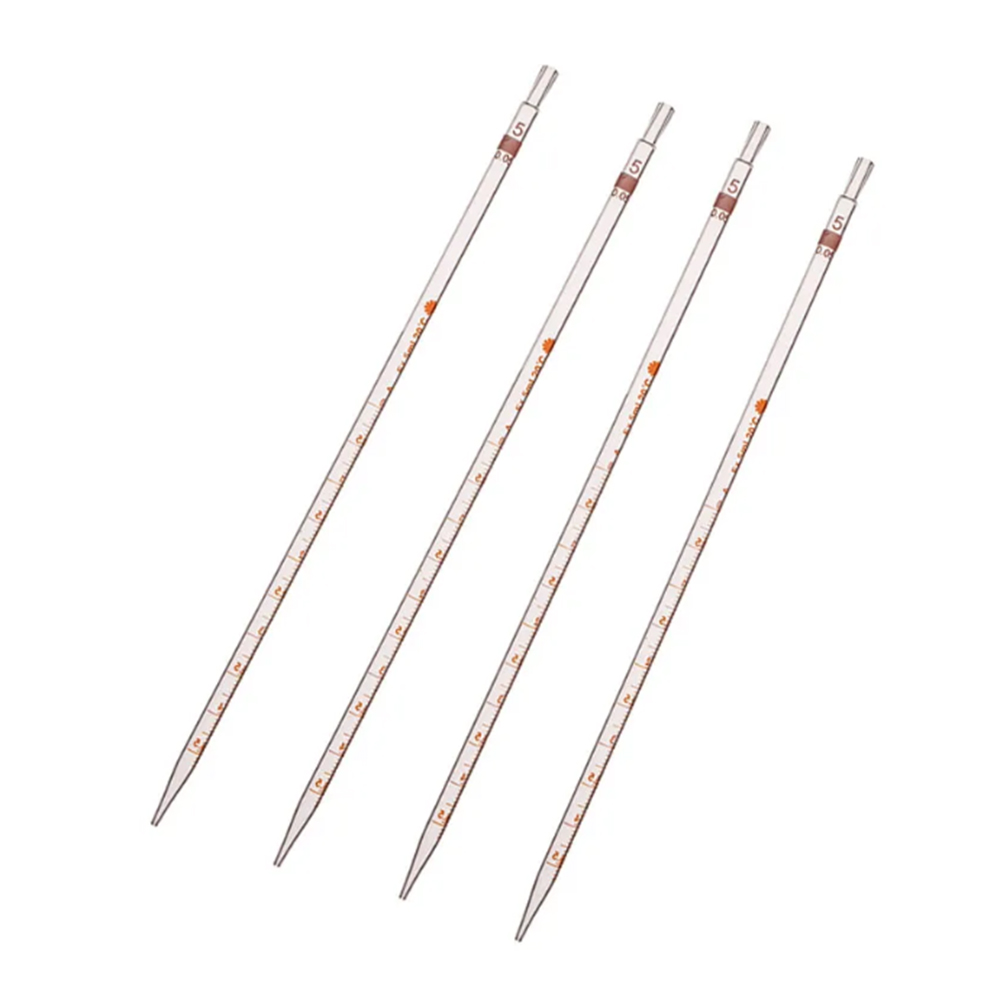
When laboratory protocols require the transfer of variable volumes, analysts must pivot to graduated designs. These instruments provide the flexibility needed for dynamic reagent addition.
For laboratories requiring durable, variable-volume solutions, investing in a high-quality graduated glass pipette ensures analysts can perform flexible transfers without sacrificing the chemical inertness provided by borosilicate glass. Clear, fused-enamel markings on these instruments are essential to maintain readability after months of aggressive cleaning.
Precision is not a luxury in pharmaceutical analysis; it is a regulatory baseline. The accuracy of a volumetric tool is determined by its manufacturing tolerances, and minor deviations can easily compound into significant analytical failures.
Laboratory glassware is universally categorized into two distinct accuracy classes based on standards established by ASTM International and ISO. Class A represents the highest level of volumetric accuracy, featuring the tightest manufacturing tolerances. For any critical assay in a regulated environment, a Class A instrument—often accompanied by a serialized certificate of accuracy—is an absolute requirement.
In contrast, Class B instruments possess tolerances that are generally twice as wide as Class A. While they are more economical and suitable for educational settings, they are explicitly prohibited in strict pharmaceutical QC environments.
Even perfectly calibrated Class A glassware is susceptible to human error during manual operation. The most common pitfall is parallax error when reading the meniscus. High-quality borosilicate instruments mitigate this risk by utilizing clear, permanent graduation marks printed with fused enamel.
Furthermore, a highly accurate glass instrument is only as effective as the mechanism used to control it. Because manual mouth pipetting is strictly prohibited due to severe safety hazards, accurate liquid handling relies heavily on mechanical controllers. To maximize ergonomic efficiency and volumetric precision, the glassware must be paired with a high-quality pipette pump. These devices allow the analyst to draw up aggressive solvents smoothly and dispense them drop-by-drop, ensuring the meniscus aligns exactly with the calibration mark.
The debate between utilizing reusable glass versus disposable plastics is a constant consideration for procurement managers attempting to balance operational budgets against laboratory throughput.
When evaluating procurement budgets, buyers must look beyond the initial unit price. Disposable plastic consumables carry a low upfront cost per unit but represent a continuous, recurring expenditure that accumulates exponentially in high-throughput facilities.
A premium borosilicate instrument requires a higher initial capital outlay but offers an extended operational lifespan. Because Type I glass withstands thousands of autoclave cycles, a single unit can remain in active service for years. Over a three-to-five-year period, the reusable model consistently demonstrates superior financial efficiency.
Pharma labs generate massive volumes of biohazardous waste, and disposing of contaminated plastics involves complex logistics and high incineration fees. Transitioning back to durable glass drastically reduces the volume of solid plastic waste. This shift not only lowers hazardous disposal costs but also tangibly demonstrates a commitment to sustainable corporate practices.
Before executing a bulk procurement contract, buyers should rigorously vet their manufacturing partners. Asking the following technical questions will help filter out unreliable vendors and ensure supply chain stability.
Do your pipettes come with ISO/DIN certification and batch certificates? Traceability is paramount. Ensure the supplier provides documented batch certificates proving the glassware strictly meets Class A standards.
How do you test for internal stress and annealing quality? Improperly cooled glass retains internal stress, leading to spontaneous breakage during use or autoclaving. Reputable suppliers use polariscopes to verify perfect annealing.
Are the graduation marks printed with chemical-resistant enamel? Standard ink will quickly wash away when exposed to harsh lab solvents or ultrasonic cleaning. Verify the use of fused, chemical-resistant enamel.
Can you provide custom modifications? Pharmaceutical testing sometimes requires modified equipment to fit unique SOPs. A strong supplier should possess the engineering capability to produce custom glassware solutions, adjusting volumetric dimensions or specialized tolerances as needed.
Choosing the right borosilicate glass pipette is far more than a routine procurement task; it is a critical safeguard for pharmaceutical safety, analytical accuracy, and regulatory compliance. By prioritizing Class A volumetric precision, Type I glass hydrolytic resistance, and proper mechanical accessories, laboratories can protect their data integrity and optimize their daily workflows.
Ultimately, investing in premium, traceable glassware from reputable suppliers yields a higher return on investment, reduces environmental waste, and ensures that your QC facility remains audit-ready at all times. Equip your analysts with the best tools available, and safeguard the quality of every batch your facility releases. For industry-leading, compliant liquid handling solutions, explore the specialized ranges at Liquan Lab to find the exact specifications your SOPs require.
While plastics are highly convenient and suitable for certain biological applications, they possess inherent chemical vulnerabilities. Plastics can leach plasticizers and additives into organic solvents. This leaching severely interferes with sensitive analytical techniques like HPLC, GC, and Mass Spectrometry. A chemically inert borosilicate glass apparatus is absolutely required for these tasks to prevent sample contamination.
Type I is a highly resistant borosilicate glass that contains boron trioxide, making it exceptionally stable thermally and chemically. It is suitable for all pharmaceutical preparations and rigorous testing. Type II glass is standard soda-lime glass that has been chemically treated on the surface to improve its resistance. However, this surface treatment can degrade over time or after repeated sterilization, exposing the reactive glass beneath. Therefore, Type I remains the mandatory choice for QC testing.
While high-quality borosilicate glass holds its internal volume exceptionally well over time, regulatory compliance requires strict oversight. Standard Operating Procedures (SOPs) in pharma QC, guided by FDA regulations and ISO standards, generally dictate that all volumetric glassware should be gravimetrically checked or formally recalibrated on an annual basis. Calibration must also be verified immediately if the instrument is dropped or if the tip appears chipped.
Yes. Borosilicate glass possesses an exceptionally low coefficient of thermal expansion, which gives it incredible thermal shock resistance. This physical property allows the glassware to be repeatedly autoclaved at standard sterilization temperatures of 121°C (250°F) without warping, melting, or losing its Class A volumetric calibration.
Abrasive cleaning methods, such as utilizing stiff wire brushes, can create internal micro-scratches that alter the calibrated volume and trap chemical residues. Best practices dictate the use of ultrasonic cleaning baths combined with specialized, non-abrasive neutral detergents. Afterward, they should be thoroughly rinsed with distilled or deionized water and dried in a dedicated laboratory oven to preserve calibration integrity.
When properly maintained, cleaned without abrasives, and handled with care to avoid physical impact, a high-quality Type I borosilicate glass pipette can last for several years. Its lifespan is generally dictated by mechanical breakage (e.g., dropping or chipping the tip) rather than chemical degradation or loss of calibration, making it an extremely cost-effective long-term investment.


